Best Publishing Platforms for Indie Authors (2026)

Prompt & help
These links share this article’s public URL with your chosen service. If the prompt doesn’t prefill, copy and paste it there.
In this article
Best Publishing Platforms for Indie Authors (2026) - TL;DR
The best publishing platforms for indie authors offer diverse features, pricing, and royalties. Self-publishing platforms help independent authors manage book creation, distribution, and sales efficiently. Choosing the right publishing tools for indie authors simplifies independent author publishing and boosts reach and profits. Here’s a side-by-side comparison of key features across top platforms.
| Platform | Interactive Mode | Read-Aloud | Offline Access | DRM Security | Analytics | White-Label Customization |
|---|---|---|---|---|---|---|
| KDP | No | Yes (VoiceView / Assistive Reader / Virtual Voice) | Yes | Basic | Basic sales data | No |
| iBooks | No | Narration via Apple only (not TTS) | Yes | Basic | Basic sales stats | No |
| Barnes & Noble Press | No | No | Yes | Basic | Basic sales stats | No |
| IngramSpark | Limited | No | Yes | Basic | Distribution reports | No |
| Smashwords | No | No | Yes | Basic | Basic dashboard | No |
| Draft2Digital | Limited | No | Yes | Basic | Basic dashboard | No |
| Kobo Writing Life | No | No | Yes | Basic | Basic dashboard | No |
| KITABOO Bytes | Yes | Yes (text-audio sync) | Yes | Advanced DRM & encryption | Comprehensive analytics | White-label brand customization |
In today’s super competitive publishing marketplace, indie or self-published authors are leading the game. As an independent author, you enjoy the distinct advantage of having total control over various aspects of your book, including content, cover design, and distribution. But being an indie writer comes with its own share of challenges. One of them is the choice of the publishing platform or tools to begin the process. To make things easier, we introduce you to the top 7 self-publishing companies for indie authors who are looking to publish their books and reach out to readers as quickly and easily as possible.
1. Kindle Direct Publishing (KDP)
KDP is one of the top choices for every indie author looking to publish their book. Owned by Amazon, Kindle Direct Publishing is a robust self-publishing platform that allows authors to directly publish their eBooks. Such is the popularity of the platform that almost 80% of all English-language eBook sales occur via Amazon, and 42% out of those, account for self-published titles.
Other key highlights of KDP
- Offers competitive royalty rates (35–70%). A top choice among self-publishing platforms for independent author publishing.
- Supports .MOBI format for eBooks, an essential feature for indie authors on self-publishing platforms.
- Allows Word-to-.MOBI conversion using free software. This simplifies independent author publishing workflows.
- The KDP Select program provides international sales expansion and higher royalties. This is ideal for independent author publishing.
- Offers enhanced marketing tools and international sales expansion visibility. This helps you optimize your book sales and profits.
2. iBooks (Apple Books)
iBooks from Apple is the second-largest eBook retailer after Amazon. An excellent publishing platform for independent authors, iBooks offers more than 40 country-specific eBook stores to give several unique benefits to authors. To be able to publish your books directly on iBooks, you must have a Mac device, or else you will have to go through an eBook aggregator. Additionally, authors can discount books for free at any time, and there are no exclusive distribution contracts to deal with.
Other key highlights of iBooks
- Allows country-specific pricing for books, making it ideal for independent author publishing globally.
- Supports local currency pricing, helping indie authors optimize their book sales efficiently.
- No exclusive distribution contracts; authors can schedule free books and discount offers anytime.
- Offers a flat 70% royalty rate, a competitive feature among self-publishing platforms for indie authors.
- Free to upload and publish books, making it one of the best publishing platforms for indie authors.
3. Barnes & Noble Press
Barnes & Noble Press is a fast, free and easy-to-use self-publishing service that enables indie authors to publish and sell directly to readers. The platform accounts for 3% of total eBook sales and also offers print-on-demand publishing.
Other key highlights of Barnes & Noble Press
- Leverages all aspects of NOOK Press to create a seamless publishing experience for indie authors.
- Designed to simplify the independent author publishing process. Authors succeed using Barnes & Noble’s expertise and resources.
- Supports both print and eBook publishing, making it versatile among self-publishing platforms.
- Books retail at Barnes & Noble physical and online stores, ensuring strong distribution reach.
- Provides tools and resources to optimize book visibility and sales for indie authors.

4. IngramSpark
IngramSpark is a self-publishing platform established by Ingram - the world’s leading distributor of print books. What makes IngramSpark a preferred choice for self-published authors is that the platform also distributes eBooks to all the top online retailers, including Kobo, Amazon, iBooks, and Barnes & Noble.
Other key highlights of IngramSpark
- Publishes hardcover books and offers premium-level printing, ideal for independent author publishing.
- Provides easy-to-use tools and support, making self-publishing platforms accessible for all indie authors.
- Supports file-to-eBook conversion, on-site advertising, and multi-platform publishing for wider reach.
- Charges commissions of 53% to bookstores and 30% to online retailers after production costs.
- Offers robust distribution options, helping authors maximize visibility across multiple retail channels.
Also Read: eBook Apps for Education
5. Smashwords
One of the largest distributors of indie eBooks, Smashwords is a well-known name in the industry. The platform makes it fast and easy for authors to publish and distribute eBooks to major retailers. In addition to this, the platform gives complete control to authors and publishers over the pricing, sampling and marketing of their written works.
Other key highlights of Smashwords
- Distributes your book to the Smashwords site and major retailers like Apple Books, Barnes & Noble, and Scribd, supporting independent author publishing.
- Provides comprehensive eBook formatting guidelines, making self-publishing platforms more accessible for indie authors.
- Enables easy conversion of books into multiple formats required by retail partners, simplifying publishing tools for indie authors.
- Offers high earning potential: up to 80% from Smashwords store sales and 60% from external retailers.
- Gives authors control over pricing, sampling, and marketing, enhancing independent author publishing flexibility.
6. Draft2Digital
Draft2Digital is an excellent platform for indie authors who are only focused on self-publishing digital books. What makes Draft2Digital stand apart is that they provide authors with access to International Book Links. This can be a huge advantage for readers not shopping on Amazon for their favourite books.
Other key highlights of Draft2Digital
- Acts as an aggregator, distributing your book to multiple retailers, simplifying independent author publishing.
- Offers a high royalty rate of 90% of your book’s retail price, ideal for indie authors.
- Charges no service fees, making it one of the most cost-effective self-publishing platforms.
- Provides free eBook formatting, streamlining publishing tools for indie authors.
- Simplifies report tracking and retailer management, enhancing efficiency for independent author publishing.
7. Kobo
Kobo is an open platform for publishing books that supports the most popular formats, including PDF and ePUB. The best part is that authors can upload their books on Kobo for free. The platform allows readers to buy and read digital content from various sources.
Other key highlights of Kobo
- Provides Kobo Writing Life (KWL), an intuitive platform for independent author publishing.
- Offers detailed sales analytics tools, helping authors track performance in real-time.
- Pays competitive royalties: 70% for books over $2.99, 45% for books below.
- Supports multiple formats, enhancing flexibility and usability for indie authors.
- Simplifies book pricing and distribution, making it one of the best publishing platforms for indie authors.
8. KITABOO Bytes
KITABOO Bytes is an e-publishing software that enables digital content creators to create and share content instantaneously. It's the perfect platform for small publishers and individual authors to self-publish and share content with a limited audience securely.
Other key highlights of KITABOO Bytes
- Allows uploading of podcasts, short videos, PowerPoint presentations, and PDF files.
- Features an easy-to-use, responsive interface for smooth independent author publishing.
- Provides DRM security with AES 128-bit content encryption for safe content distribution.
- Includes analytics tools to track user engagement and content consumption effectively.
- Supports content delivery on mobiles, tablets, and desktops, enhancing reach for indie authors.
- Offers read-aloud and interactive features, making it one of the best publishing platforms for indie authors.
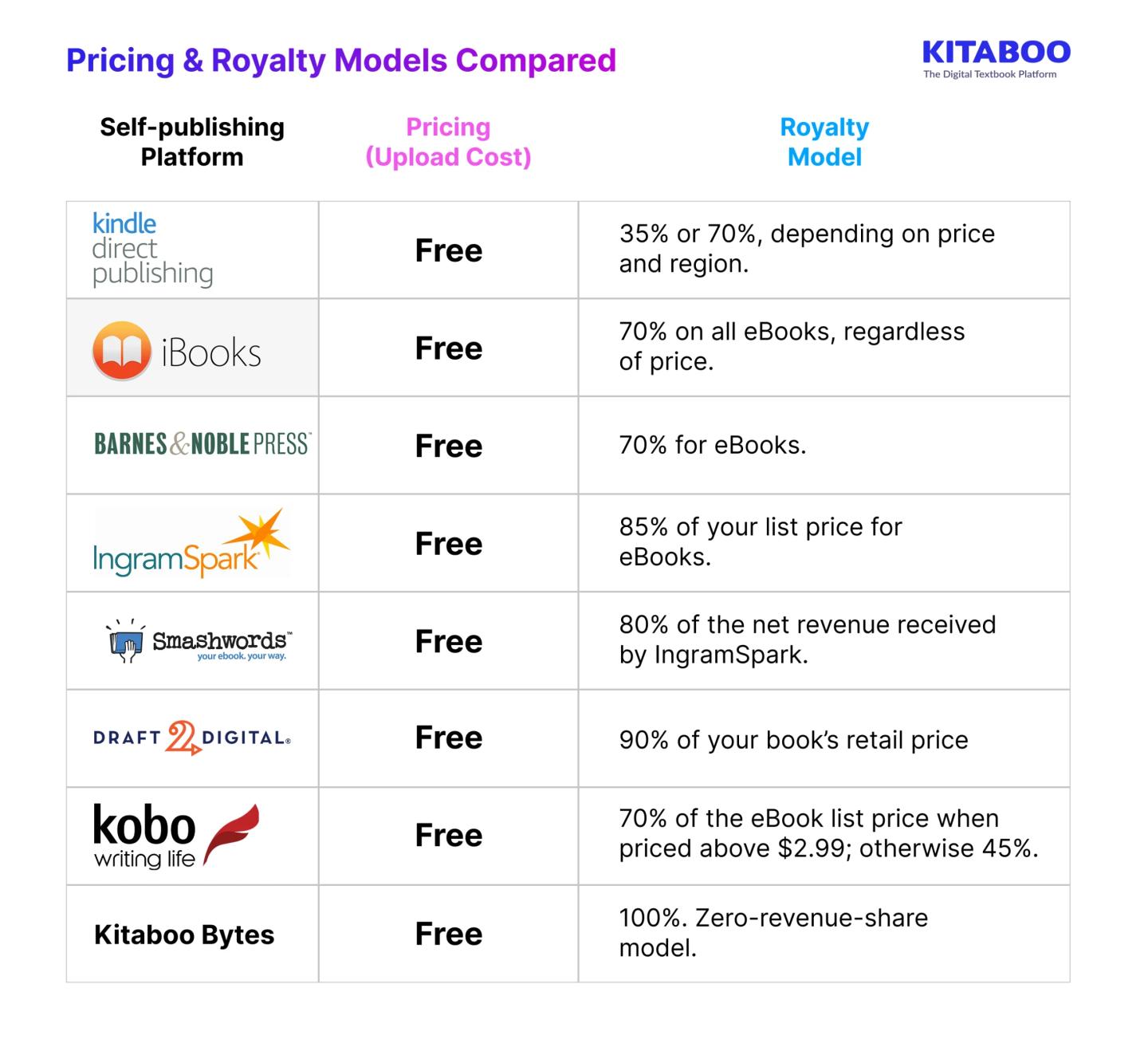
Pricing & Royalty Models Compared
Choosing the right self-publishing platform depends on pricing and royalty rates. Different self-publishing platforms offer varying earning models, so indie authors should compare them closely. This table simplifies the decision-making process for anyone exploring the best publishing platforms for indie authors.
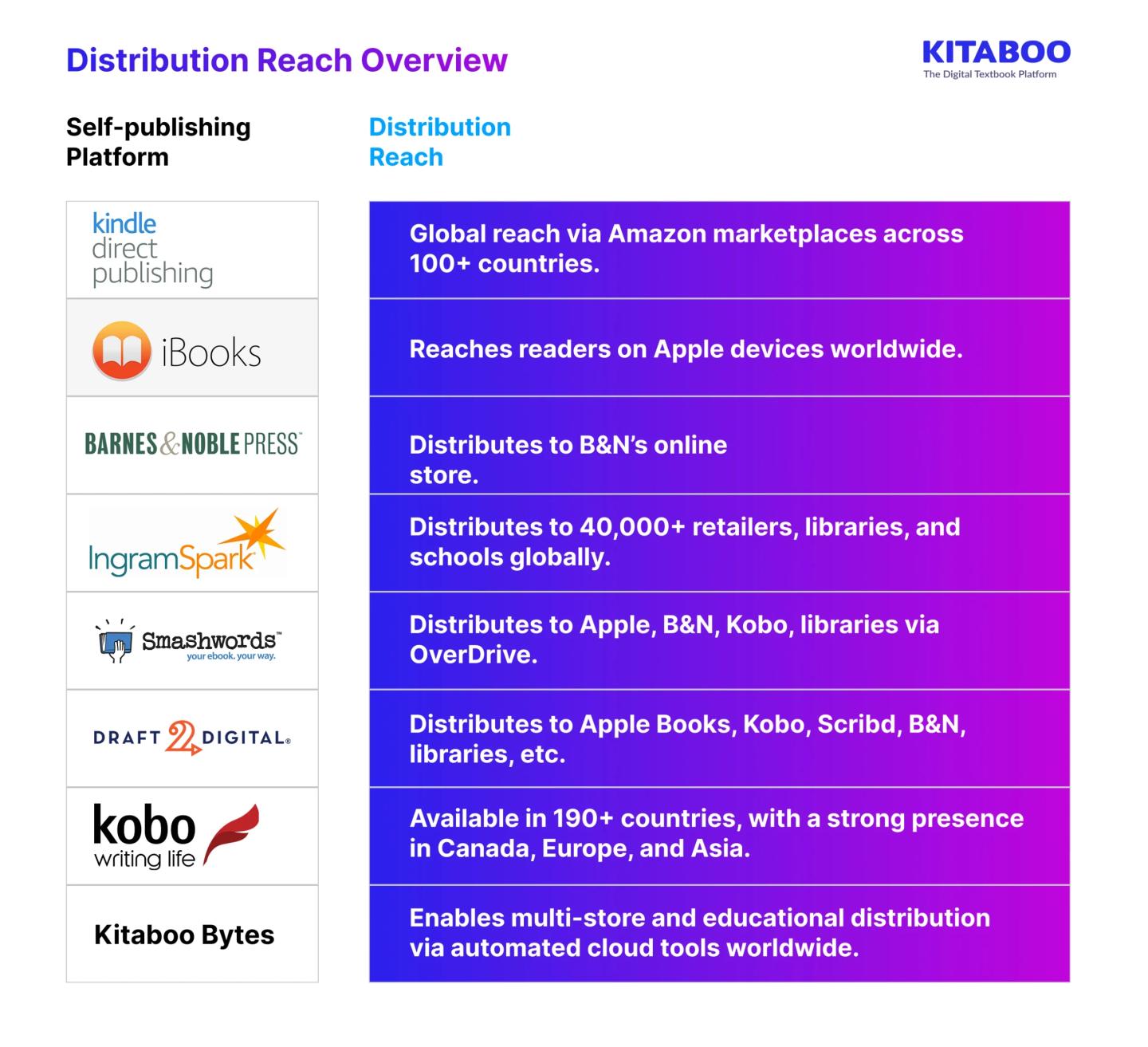
Distribution Reach Overview
When exploring the best publishing platforms for indie authors, knowing their distribution reach is essential. Each self-publishing platform offers a unique network. Understanding distribution helps you make smarter independent author publishing decisions. It also guides you in selecting the best publishing tools for indie authors.
How to Choose the Right Platform?
Selecting the right self-publishing platform is crucial for independent author publishing success. Not all platforms offer the same features, reach, or tools. Evaluating your priorities helps you choose among the best publishing platforms for indie authors. Using publishing tools for indie authors wisely ensures maximum efficiency and better results.
1. Consider Your Distribution Needs
Distribution determines how far your book reaches readers globally. Some self-publishing platforms focus on retail stores, others include libraries, educational networks, or print-on-demand. Evaluating distribution options ensures your independent author publishing goals are met. Choosing the right reach helps your book find the intended audience effectively.
2. Evaluate Pricing and Royalties
Pricing models and royalties vary across self-publishing platforms. Compare upfront costs, commission rates, and potential earnings. Understanding pricing and royalties is essential for independent author publishing planning. Selecting platforms with transparent and fair terms maximizes profits and supports long-term success.
3. Check Supported Formats and Tools
The best publishing platforms for indie authors support multiple formats like EPUB, PDF, and MOBI. Publishing tools for indie authors, such as formatting options, conversion software, and multimedia support, simplify the process. Choosing platforms with broad format support ensures your content works across devices and reaches more readers.
4. Assess Marketing and Promotional Features
Marketing capabilities directly impact visibility and sales. Self-publishing platforms with built-in promotional tools, email campaigns, or analytics help independent author publishing efforts. Using the right publishing tools for indie authors allows better engagement with readers. Evaluating these features ensures your book stands out in a crowded marketplace.
5. Review Support and Community Resources
Customer support, tutorials, and active author communities enhance your publishing experience. Self-publishing platforms that provide responsive help and peer advice improve independent author publishing outcomes. Access to knowledge and resources through publishing tools for indie authors saves time and reduces errors.
6. Look for Exclusive vs Non-Exclusive Options
Some platforms require exclusive distribution while others allow multi-platform publishing. Choosing non-exclusive options gives independent authors flexibility. Evaluating exclusivity helps you maximize distribution and select the best publishing platforms for indie authors. This ensures long-term control over your work and revenue streams.
In a nutshell
When it comes to eBook publishing platforms, there is no dearth of options that indie authors can look at. Irrespective of what your budget and goals are, you are guaranteed to find a platform that fits your specific requirements. All you need to do is research thoroughly, consider all the features, weigh the advantages and disadvantages, then proceed with the option that you feel most confident about. Contact our expert team now and get started! To know more, please write to us at contact@kitaboo.com Suggested Reads:
- Benefits of Using SDKs in Improving the User Experience of Educational Software and Apps
- Boost Your Educational Publishing Business with the Best Authoring Platform
- Boost Your K12 Publishing Business with the Best Online eBook Maker
- Best PDF eBook Readers for Windows and Android
- The Future of Educational Publishing
- Best Apps to Read PDF Books on Android Devices
- eBooks vs. Printed Books
- Online Learning is Better than Classroom Learning
- Modules Your Compliance Training Resources Must Include
- eLearning Training Solutions
- Mobile-based Corporate Training