
KitabooKitabooKitabooKitaboo
  • Live Demo
  • Pricing
  • Solutions
    • K.AI
    • KITABOO for K12 Publishers
    • KITABOO for Associations and Non-profit
    • KITABOO for Higher Education Publishers
    • Convert Fixed PDF / InDesign to Dynamic Content
    • Digital Publishing
    • Training Solutions
    • eBook Store
  • Kitaboo Readers
    • Online Reader
    • iOS App
    • Android App
    • Windows Store Installer
    • Mac Store Installer
  • Kitaboo SDK
  • Resources
    • Blog
    • Infographics
    • Product Videos
    • Case Studies
    • Whitepapers
    • Webinars
    • How To Guides
    • Kitaboo FAQs
  • Request A Demo
Augmented Reality technology in Education

Is Augmented Reality Technology The Future of Education ?

By Vishal Dani | Education Technology | 0 comment | 24 April, 2023 | 5

Technologies like Augmented Reality, that enrich the standard methods of imparting education are always in demand, now more than ever. The newer methods of teaching enable post-session content accessibility, contextual relevancy, personal attention, up to date courseware. A big disadvantage of using the traditional Instructor-led classroom is its inability to address individual learner needs, leading to a lack of attention and interest among students.

This is where modern technologies like Augmented Reality come in. AR, VR, MR are technologies which provide visuals to learners that can enrich the learning experience and assist the educators in creating content that links visuals to reality. For educators, technologies like this offer a method of delivering content that makes learning interesting and easier to understand.

What we will discuss in this post?

  • What is Augmented Reality Technology?
  • How does Augmented Reality Technology Work?
  • What is the scope of Augmented Reality Technology?
  • What are the applications of Augmented Reality Technology in Education?
  • What are the advantages of using Augmented Reality Technology in Education?

What is Augmented Reality Technology?

Augmented reality is a technology with which one can enhance reality by adding a layer of information which is superimposed over the actual visuals. This layer of computer-generated images is visible when one points their device camera at specific points. This action displays a visual that enhances learning with better visual and sensory experience.

To put it simply, users see layers of digital information covering real-world images, which can improve their experience and understanding of reality.

How Does Augmented Reality Technology Work?

Augmented reality technology has 3 types –

  • Location-based AR: This technology displays information based on a device’s geo-location.
  • Projection-based AR: In this case, AR software sends light to an object which creates an interactive dashboard in a real environment.
  • Superimposition-based AR: This type of AR allows users to replace the actual image, adding new elements to the viewpoint.

So, if a student scans the AR-enabled content with an AR application on their device, they will be able to view all visuals linked to the concepts in their courseware.

What is the Scope of Augmented Reality Technology?

The AR and VR market is expected to reach a market size of $215 billion within 3 years. The number of AR and VR users is expected to cross the 1 Billion mark by 2020.

The number of smartphones sold to users had crossed the 1.5 billion mark as of 2017

What are some Applications of Augmented Reality in Education?

  • Enables discovery and learning
  • Objects modeling
  • Interactive eBooks
  • Skills training
  • Stimulation or scenario based learning
  • Gamification

What are the Advantages of using Augmented Reality technology in Education?

1. Better User Interaction:

Interactive courseware results in increased involvement with learners since they can access engaging content from their smartphones. Users need to scan the content through their devices to view a computer-generated visual which leads to better understanding of a concept along with some links to digital assets that can provide additional information. Augmented Reality in education can entice learners to access the courseware due to its enriched experience.

2. Cost Efficiency:

Creating, updating and distributing printed courseware along with related support props to enable learning in traditional setups is a big investment for institutions. Whereas integrating Augmented Reality in education allows cheaper and easier creation, alteration and deployment of digital content where almost negligible print costs are incurred; AR-enabled content and all its visuals can be viewed on a reader’s device itself allowing BYOD scenario. Hence, improving ROI for institutions as well as the publishers.

3. Contextual Relevancy:

Content in physical books is restricted to text and images that only allow learners to view the images and assume how an equipment functions. Whereas integrating augmented reality in education enables the course creator to take advantage of the technology at hand to create and deploy 3D visuals that interactive to user’s touch. This provides contextual relevancy and leaves no space for assumption because the educator can display how equipment functions in real life.

4. Better Engagement:

Integrating augmented reality in education courseware can be appealing for the learners resulting in better engagement with the educational content. All the sessions delivered by the educators in traditional setups can be enhanced if supported with supplementary AR-enabled content

Is Augmented Reality Technology the Future of Education?

The education system all over the world was only following traditional instructor-led teaching approach. Integrating technologies can enrich and bring in benefits for educational institutions, educators as well as learners enriching the entire learning experience.

Specifically talking about integrating Augmented Reality in education, it can lend many benefits, like motivating students to learn, transforming classrooms and learning methods with interactivity or supporting students learn faster and retain better.

The attention span of humans has dramatically fallen over the years, in scenarios like these technology-assisted learning can in some cases address the issue. Along with technologies like Virtual Reality, Mixed Reality, Augmented Reality can collectively change the traditional learning methods by enriching the experience.

Augmented reality cannot singularly address each and every issue with traditional learning methods to redefine the future of education. Educational institutions, publishers should be agile enough to identify the disruptors and accordingly strategize to carve out a competitive advantage for themselves by offering a better experience to end users.

Partnering with innovative and technology-driven digital content transformation, eLearning, and digital publishing organizations can assist publishers and institutions to deliver robust learning experiences assisted by technologies like AR, VR and the like.

DISCOVER HOW AN INTERACTIVE EBOOK PUBLISHING & DELIVERY PLATFORM CAN HELP YOU
Kitaboo is a cloud-based content platform to create-publish & distribute interactive mobile-ready ebooks.
REQUEST DEMOREAD MORE

You May Also Like

  • How AR can transform the classroom?
    How Augmented Reality Can Transform the Classroom?

    Education Technology / February 2, 2024

  • Google Classroom
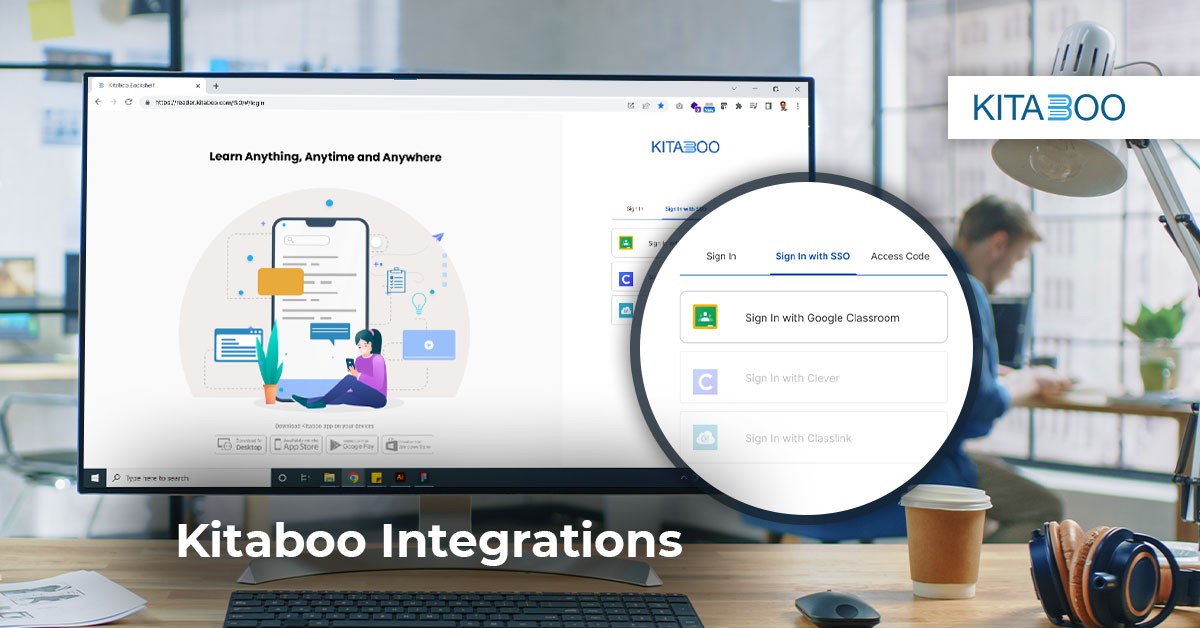
    KITABOO seamlessly integrates with Google Classroom to deliver robust content securely

    Digital Publishing,eBook solution,Education Technology / April 9, 2023

  • stem education
    Future of STEM Education: Top 4 Reasons Why It Is Important In 2024

    Blog,Digital Publishing,eBook solution,Education Technology / January 9, 2024

AR, Augmented Reality, Augmented Reality in Education, Education

More Resources

  • Whitepapers
  • How To Guides
  • Product Videos
  • Infographics
  • Kitaboo FAQs

Request a Demo

An enterprise platform that 15 million users trust

Follow Us

Kitaboo Product Video

Recent Posts

  • digital reading
    10 June, 2024
    0

    What is Digital Reading? Top 7 Advantages of eReading (2024)

  • Digital Publishing Platform for Higher Education
    7 June, 2024
    0

    Revolutionize Higher Education with Top Digital Publishing Platforms

  • Higher Ed Textbook Publishers
    7 June, 2024
    0

    The Future of Textbooks: Free Resources and Tech Solutions

  • eBook to Audiobook Converters
    7 June, 2024
    0

    Narrate Your Story: eBook To Audiobook Conversion

Categories

  • Blog
  • Digital Publishing
  • DRM for eBooks
  • eBook solution
  • eBook Store
  • eCommerce
  • Education Technology
  • Employee Training
  • Enterprise
  • ePUB Conversion
  • Frankfuter Buchmesse
  • Higher-ed
  • K12
  • Nonprofit Organizations & Associations
  • SDK
  • Self-publishing
  • Trade
  • Uncategorized
  • XML Conversion

Get the latest posts delivered right to your email.

Sign up to Newsletter

Press & media

  • Press Releases
  • News Section
  • Events
  • Infographics

Quick links

  • About us
  • About Hurix Systems
  • KITABOO for K12 Publishers
  • KITABOO for Associations and Non-profit
  • KITABOO for Higher Education Publishers
  • Digital Content Solutions – HurixDigital
  • Contact Us
  • Terms and Conditions
  • Privacy Policy
  • Cookie Policy
  • Careers

Resources Links

  • How To Guides
  • Blog
  • Product videos
  • Kitaboo Partner Program

Kitaboo Reader

  • Hurix System' best in class interactive ebook reader application Kitaboo is now available on the Applie Itunes app store
  • Hurix System' best in class interactive ebook reader application Kitaboo is now available on the Google Play store
Copyright © 2024  KITABOO - The Digital Textbook Platform. | All Rights Reserved | Developed by FRD Studio
  • Live Demo
  • Pricing
  • Solutions
    • K.AI
    • KITABOO for K12 Publishers
    • KITABOO for Associations and Non-profit
    • KITABOO for Higher Education Publishers
    • Convert Fixed PDF / InDesign to Dynamic Content
    • Digital Publishing
    • Training Solutions
    • eBook Store
  • Kitaboo Readers
    • Online Reader
    • iOS App
    • Android App
    • Windows Store Installer
    • Mac Store Installer
  • Kitaboo SDK
  • Resources
    • Blog
    • Infographics
    • Product Videos
    • Case Studies
    • Whitepapers
    • Webinars
    • How To Guides
    • Kitaboo FAQs
  • Request A Demo
Kitaboo
We use cookies on our website to give you the most relevant experience by remembering your preferences and repeat visits. Read our "Privacy Policy" and "Cookie Policy"
Cookie SettingsAccept All
Manage consent

Privacy Overview

This website uses cookies to improve your experience while you navigate through the website. Out of these, the cookies that are categorized as necessary are stored on your browser as they are essential for the working of basic functionalities of the website. We also use third-party cookies that help us analyze and understand how you use this website. These cookies will be stored in your browser only with your consent. You also have the option to opt-out of these cookies. But opting out of some of these cookies may affect your browsing experience.
Necessary
Always Enabled
Necessary cookies are absolutely essential for the website to function properly. These cookies ensure basic functionalities and security features of the website, anonymously.
CookieDurationDescription
cookielawinfo-checkbox-analytics11 monthsThis cookie is set by GDPR Cookie Consent plugin. The cookie is used to store the user consent for the cookies in the category "Analytics".
cookielawinfo-checkbox-functional11 monthsThe cookie is set by GDPR cookie consent to record the user consent for the cookies in the category "Functional".
cookielawinfo-checkbox-necessary11 monthsThis cookie is set by GDPR Cookie Consent plugin. The cookies is used to store the user consent for the cookies in the category "Necessary".
cookielawinfo-checkbox-others11 monthsThis cookie is set by GDPR Cookie Consent plugin. The cookie is used to store the user consent for the cookies in the category "Other.
cookielawinfo-checkbox-performance11 monthsThis cookie is set by GDPR Cookie Consent plugin. The cookie is used to store the user consent for the cookies in the category "Performance".
viewed_cookie_policy11 monthsThe cookie is set by the GDPR Cookie Consent plugin and is used to store whether or not user has consented to the use of cookies. It does not store any personal data.
Functional
Functional cookies help to perform certain functionalities like sharing the content of the website on social media platforms, collect feedbacks, and other third-party features.
Performance
Performance cookies are used to understand and analyze the key performance indexes of the website which helps in delivering a better user experience for the visitors.
Analytics
Analytical cookies are used to understand how visitors interact with the website. These cookies help provide information on metrics the number of visitors, bounce rate, traffic source, etc.
Advertisement
Advertisement cookies are used to provide visitors with relevant ads and marketing campaigns. These cookies track visitors across websites and collect information to provide customized ads.
Others
Other uncategorized cookies are those that are being analyzed and have not been classified into a category as yet.
SAVE & ACCEPT